
Har Mod ki Kahani
Dungarpur
Dungarpur sits in Rajasthan's far south and is fondly called the City of Hills. Tradition holds that Rawal Veer Singh of Mewar founded it in 1258 CE. The land was then held by a Bhil chieftain named Dungaria, and after defeating him in battle the prince named the new town in his honour. Green hills, still lakes and the folk tales of the Vagad region give the place its character.
The stories
7 places, and what happened at each
Gaib Sagar Lake and Badal Mahal
HistoryGaib Sagar Lake spreads out in the middle of Dungarpur and is the calmest corner of the town. On its bank stands Badal Mahal, built of the local pareva stone whose blue-green sheen catches the water. Its design is usually described as Rajput grandeur mixed with the fine detailing of Mughal craft. By tradition the palace served the royal family chiefly as a rest house and guest lodge, where rulers put up visitors and idled away afternoons in the cool breeze off the lake. At dusk the domes are mirrored across the surface.
Kalibai Memorial
HistoryA memorial park on the shore of Gaib Sagar honours Kalibai, the bravest daughter of the Vagad country. In 1947, the rulers of Dungarpur state moved to shut down the school in Rastapal village, and their officials and police began dragging its teacher behind a vehicle to which he had been tied. Kalibai, a tribal girl said to be only twelve or thirteen, ran forward and cut the rope with her sickle. The men opened fire, and she died of her wounds. Her sacrifice for the cause of education remains the greatest source of pride in the Vagad region.
Juna Mahal
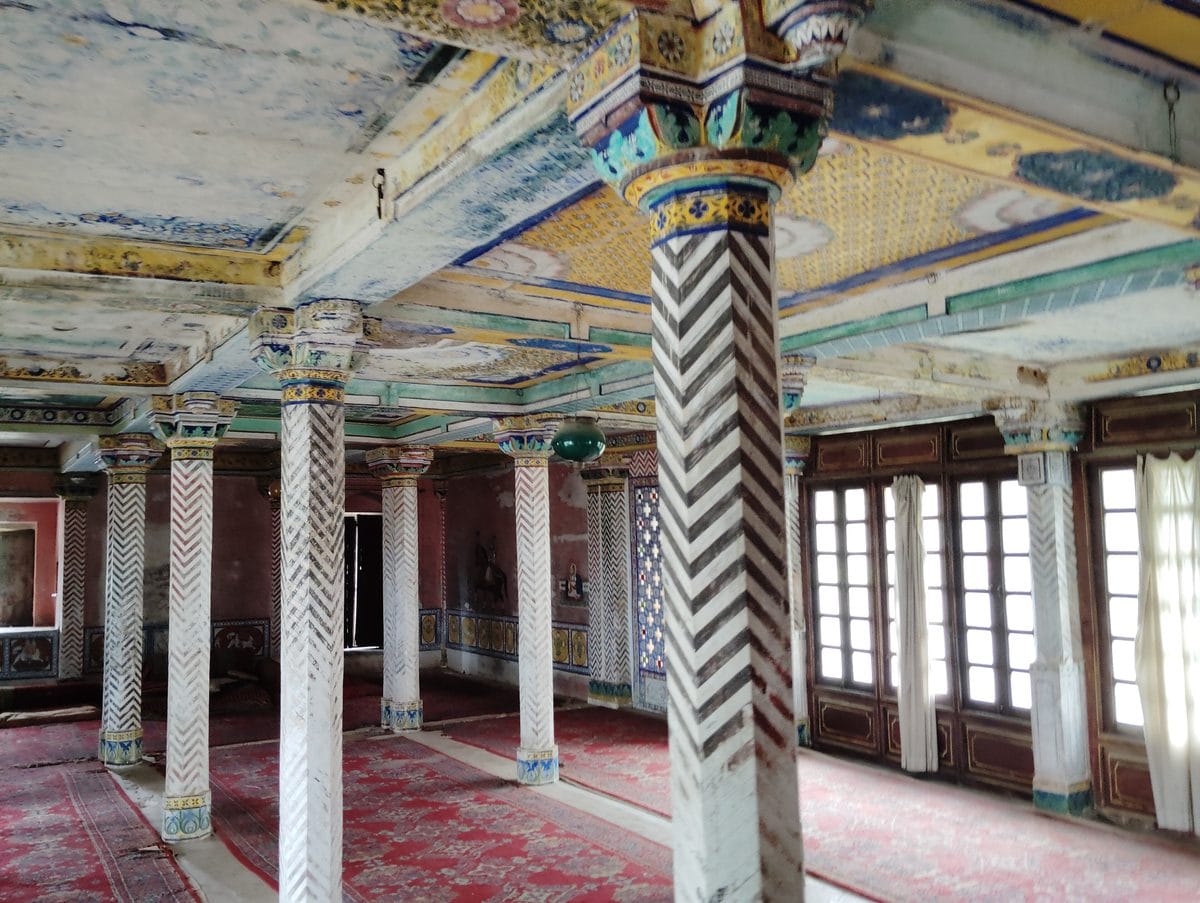
History & legendJuna Mahal rises at the foot of Dhanmata hill and looks more like a fort than a palace from outside. Its seven storeys were never built in one go: successive rulers simply added another level whenever they felt the need, so the old palace grew upwards across the centuries — from the thirteenth, by tradition, though the date is disputed. Inside, the frescoes and mirror work still glow. Local people say the corridors were laid out as a deliberate maze, so that any attacker who got in would lose himself among the passages while the guards closed in.
Baneshwar Dham
History & legendA drive out from Dungarpur, where the Som, Mahi and Jakham rivers meet, Baneshwar Dham is reckoned the greatest pilgrimage of the region's tribal communities, often called their own Kumbh. What sets it apart is the object of worship: a broken shivling. The story goes that a cow's hoof once struck the stone and split it in five places. Custom normally forbids worshipping a damaged idol, but here, by a tradition local people trace to Sant Mavji, this cracked lingam is honoured with full ritual.
Deo Somnath Temple
History & legendStanding in white stone on the bank of the Som river, Deo Somnath is old enough that no record now fixes its age — by tradition it is reckoned at roughly eight hundred years. It is said the temple was tucked behind low hills so that it stayed out of sight, an old precaution against raiders, and visitors like to compare its form to the Somnath temple in Gujarat. The astonishing part is the construction: no lime, cement or mortar was used anywhere. The blocks were cut with grooves and slotted into one another, an interlocking system that has held them firm for centuries.
Udai Bilas Palace
HistoryBuilt by Maharawal Udai Singh II, Udai Bilas Palace now works as a luxury heritage hotel without having lost any of its poise. It is carved from the local pareva stone, whose bluish-grey cast shifts with the hour of the day. Its most remarkable feature sits inside: the Ek Thambiya Mahal, a densely carved pavilion that rests on a single central pillar. That pavilion is older than the palace enclosing it — raised not by Udai Singh but by an earlier ruler, Maharawal Shiv Singh, as a Shiva shrine held in memory of Gyan Kanwar.
Shrinathji Temple
History & legendOn the edge of Gaib Sagar Lake stands the Shrinathji Temple, dedicated to Krishna and counted among the holiest spots in Dungarpur. It is credited to Maharawal Punjraj, and is said to have been raised in 1623 CE. Local legend relates that during Aurangzeb's reign, when idols were being destroyed, the original image of Shrinathji was carried out of the Mathura-Vrindavan region and kept in secret at this very temple for a while as it travelled towards safety. The image did reach Nathdwara, and that story gives the temple a special standing among Vaishnav devotees.
Keep going
Next on the road
Your Rajasthan Story Starts Here.
Tell us where you want to go. We will help you make the journey unforgettable.