
Har Mod ki Kahani
Dholpur
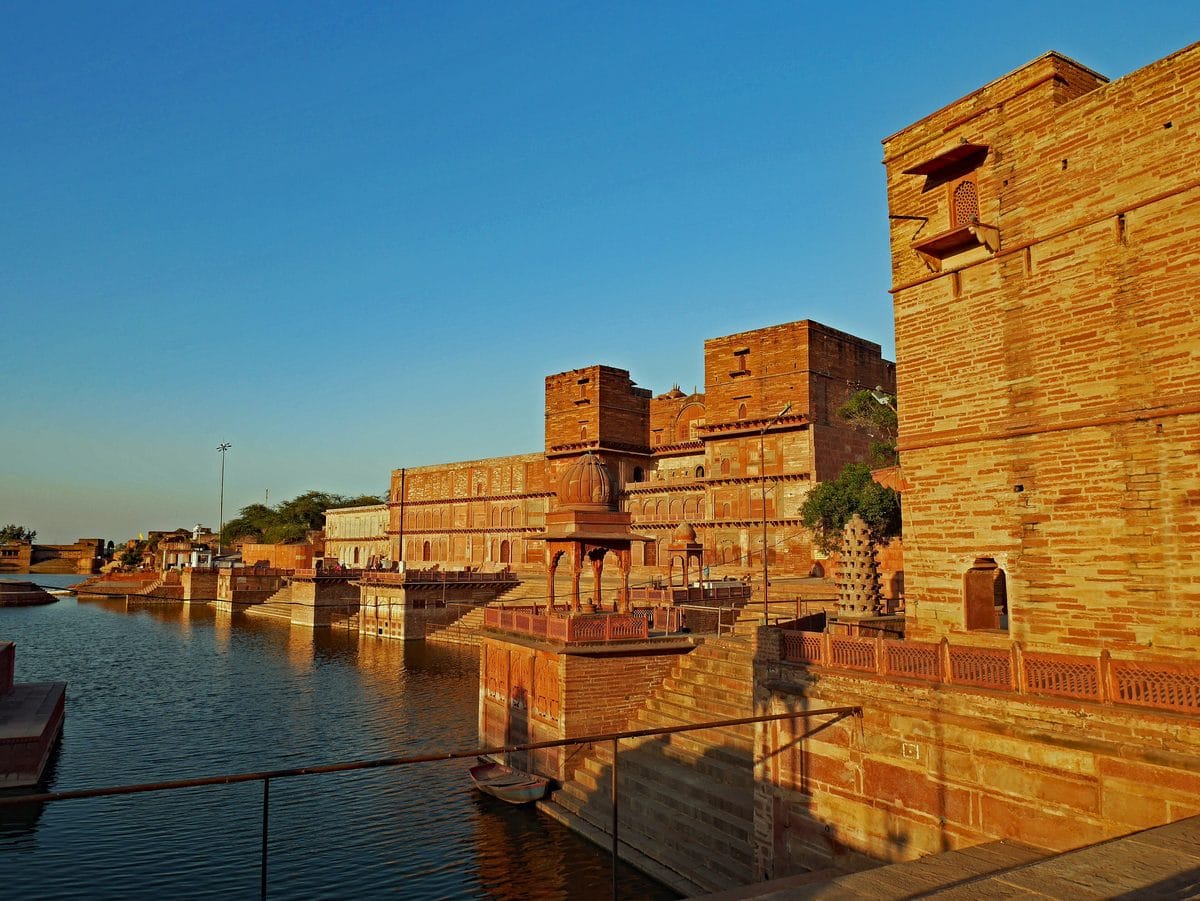
Dholpur is known as the Red Diamond City, the land of red stone. The Chambal river, its rugged ravines and the distinctive red sandstone quarried here have made the town famous well beyond Rajasthan. Alongside its historic buildings, Dholpur is equally celebrated for its mythology — forts, a clock tower, tombs, a royal hunting lodge and a sacred lake, each carrying a story of its own.
The stories
5 places, and what happened at each
Machkund Sarovar
LegendLegend holds that Muchukunda, twenty-fourth king of the solar dynasty and a forefather of Rama, fought alongside the gods against the demons. Worn out, he slept in a cave said to be here, and the gods granted that whoever disturbed his sleep would burn to ashes. Later Krishna, having lured the demon Kalayavana from the battlefield — hence, it is said, the name Ranchhod — hid in that cave and laid his yellow robe over the sleeping king. Kalayavana kicked him, taking him for Krishna, and burnt to ashes the moment the king's eyes opened. Held sacred ever since, the lake is popularly called Teerthon ka Bhanja, the nephew of all pilgrimages.
Shergarh Fort
HistoryStanding on the bank of the Chambal, Shergarh is one of Dholpur's best-known old ruins. By tradition it was first raised by a ruler named Maldeo — some accounts make him a raja of Dholpur, others the ruler of Jodhpur. Its later name comes from Sher Shah Suri, sultan of Delhi from 1540, who is credited with repairing and strengthening the fort and renaming it Shergarh after himself. It is said that from these walls the routes running towards Malwa and southern India could be watched. Today a quiet ruin keeps its old guard above the ravines.
Nihal Tower
HistoryRising from the middle of Dholpur town, the Nihal Tower is the city's best-known landmark. This clock tower is said to stand about 150 feet high, and is popularly counted among the tallest in Rajasthan. Tradition holds that work began in the 1880s under Maharaja Nihal Singh, whose name it carries, and that construction dragged on so long that it was Maharaja Udaybhan Singh who finally saw it finished. The design blends British and Rajasthani craftsmanship, and the tower still keeps watch over the busy streets and markets that circle its base.
Gajra Ka Maqbara
History & legendMaharaja Bhagwant Singh of Dholpur raised this tomb for Gajra, the companion he loved above all others and whom tradition remembers as his paswan. Local historians say it was conceived along the lines of the Taj Mahal at Agra, with two graves set side by side. The work was begun and much of that fine detail survives, but the monument was never finished. That incompleteness became its identity: people call it the unfinished Taj, or simply Dholpur's own Taj Mahal — a half-written love letter in stone the town has never quite let go of.
Talab-e-Shahi and Khanpur Mahal
HistoryA short drive from Dholpur, the lake called Talab-e-Shahi and the Khanpur Mahal on its bank are relics of Mughal leisure. The lodge is said to have been built around 1617 for Prince Khurram, the future emperor Shah Jahan, who by tradition was fond of hunting in the thick forests around Dholpur and needed somewhere suitably royal to stay. The palace and the still water still work together as a single picture, and it takes very little imagination to see the imperial party riding out at dawn and returning to spend the night beside the lake.
Keep going
Next on the road
Your Rajasthan Story Starts Here.
Tell us where you want to go. We will help you make the journey unforgettable.