
Har Mod ki Kahani
Jodhpur
Jodhpur, the blue city on the edge of the Thar, is the old heart of Marwar, and almost every lane here carries a story of its own. A fort on a high ridge, royal memorials in white marble, the gardens of an older capital and a market that never quite empties — history and folklore run side by side. Here are the places worth your time and the tales attached to them.
The stories
5 places, and what happened at each
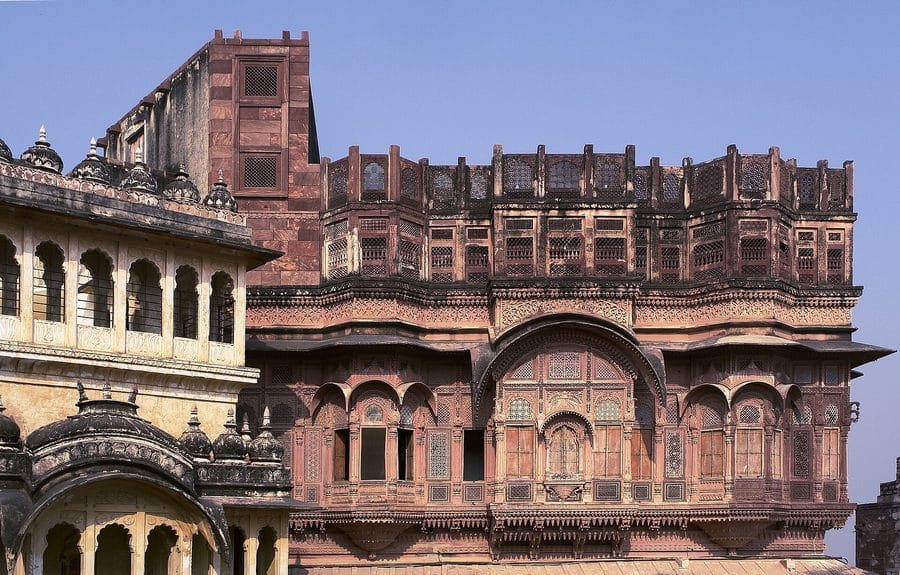
Mehrangarh Fort
History & legendOften described as one of India's largest forts, Mehrangarh was begun in 1459 by Rao Jodha. Local telling has it that the hill he chose was already home to a hermit, Cheeria Nathji, who had to give up his seat so the walls could go up. Angered, he is said to have cursed the land with drought. To settle the curse, the story goes, a man named Raja Ram Meghwal offered himself and was buried alive in the foundations. The fort's name, though, comes from mehran, the sun. Inside stands the Chamunda Mata temple, shrine of the royal family's patron goddess.
Umaid Bhawan Palace
HistoryUmaid Bhawan was completed in 1943, commissioned by Maharaja Umaid Singh of Jodhpur; work is said to have begun in 1928. Marwar was then in the grip of a punishing drought, and work had dried up along with the wells; the palace was begun as relief, putting thousands of hands to paid labour for well over a decade. It is also called Chittar Palace, after the Chittar hill that gave it both its site and its stone. The building is now divided three ways — the royal family still lives in one wing, another is a luxury hotel, and the third holds a museum.
Jaswant Thada
HistoryBuilt of milky white stone, Jaswant Thada is often called the Taj Mahal of Marwar. Maharaja Sardar Singh raised it in 1899 in memory of his father, Maharaja Jaswant Singh II, and it has served ever since as the royal cremation ground and memorial site of Jodhpur's Rathore rulers. The marble is cut so thin that sunlight seems to pass through it, leaving the whole structure glowing from within. Standing close to Mehrangarh, a little apart from the traffic, it is the quietest corner in the city and visitors tend to linger far longer than they planned.
Mandore Garden
History & legendMandore was the seat of Marwar long before Jodhpur was founded — the old capital from which the region was ruled. Folklore holds that Mandodari, wife of Ravana, grew up here, and a temple to Ravana stands at Mandore. The gardens today hold the devals, or cenotaphs, of the Marwar kings standing in a row, a hall of big figures cut from a single rock — the region's folk heroes and their gods — and, on the slope above, the weathered ruins of Mandore fort. Walking under the old trees, the place reads rather like a book left open.
Ghanta Ghar & Sardar Market
HistoryThe clock tower at the heart of the old city is Jodhpur's landmark. Maharaja Sardar Singh had it built a little over a century ago, and it has kept time over the neighbourhood ever since. Sardar Market spreads out around its base and stays busy from early morning until late in the evening: stalls of Rajasthani handicrafts, mounds of spices, handloom cloth, bangles and famous local sweets follow one another down the narrow lanes. Keep the tower in sight as you wander and you will not lose your way in the crowd.
Keep going
Next on the road
Your Rajasthan Story Starts Here.
Tell us where you want to go. We will help you make the journey unforgettable.