
Har Mod ki Kahani
Jalore
Tucked into Rajasthan's south-western corner, Jalore was known in older texts as Jabalipur. Its granite hills carry forts that armies struggled for years to breach, its Aravalli ridges hold temples reached by ropeway, and its people carry a long memory of defiance. Travellers come for the stone carving and the hilltop views, and stay for the stories that every wall and shrine seems to hold.
The stories
5 places, and what happened at each
Jalore Fort (Swarnagiri Fort)
History & legendPerched about 1,100 feet above the town on a granite outcrop, the fort of Swarnagiri was long counted among the hardest in India to take. Alauddin Khilji's army closed on Kanhaddev Chauhan's Jalore in 1310, and the fort fell on 11 May 1311. Tradition holds that the main gate stood for years, that a greedy chieftain betrayed a rough back path, and that the sultan bought every sack of mustard seed in town overnight, scattering it so the sprouts would show the damp, weaker stonework. A Marwari proverb is said to date from that night. Kanhaddev and his son Viramdev fell fighting; the fort's women, by tradition, chose jauhar.
Topkhana
History & legendThe building at the heart of Jalore town is called the Topkhana today, but it began life as something quite different. Tradition holds that the Paramara king Bhoj raised it as a grand Sanskrit school and shrine, drawing students from far beyond Marwar — the century is disputed, though it clearly predates the Sultanate. After Alauddin Khilji took the town it was pulled about and repurposed as a mosque; only much later did it serve as an artillery store, which is where the name comes from. Walk among the pillars and arches now and the older building still shows through, in carving that has outlasted every change of use.
Sundha Mata Temple
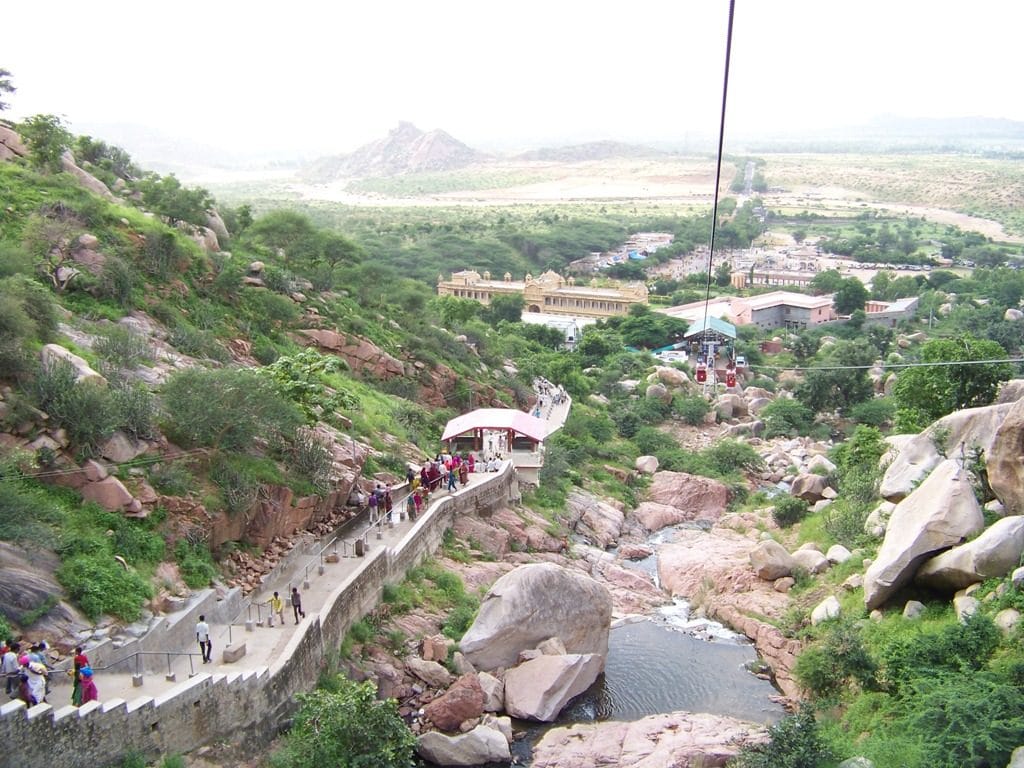
History & legendHigh on the Aravalli ridges, the Sundha Mata temple is the most revered spot in Jalore district. It is said to be some nine hundred years old, and here the goddess Chamunda is worshipped as Sundha Mata. By tradition, devotion is offered to the head alone: the belief is that Sati's head fell at this spot. The caves in these hills carry their own stories — local memory holds that in times of war the Rajput rulers of Jalore and the country around sheltered in them, a strategic refuge beside a holy one. Rajasthan's first ropeway was opened here, and it lifts you over a widening view of the valley.
Shri Sire Mandir
History & legendSet on the Kalashachal hill, about 646 metres above sea level, Shri Sire Mandir is the quietest corner of Jalore. Tradition holds that the ruler Ratan Singh raised this Shiva shrine on ground long held sacred to the sage Jabali, who is said to have performed severe penance here; it is from the sage's name that the whole region was once called Jabalipur. A second strand of folklore adds that the Pandavas passed some of their years of exile on this hillside. Whatever draws you up the path, it is the thin air and the silence at the top that make most travellers stay longer than they planned.
Jahaj Mandir (Mandwala)
HistoryThe Jahaj Mandir at Mandwala is a Jain shrine built entirely in white marble, and its shape has made it talked about well beyond Rajasthan. Its foundation stone was laid in 1993, but the finished temple was not inaugurated until 1999 — raised, stone by stone, in the exact form of a ship. For Jain devotees the design is the whole point of it: as a vessel carries passengers safely across the sea, so the boat of faith carries a person across the ocean of worldly existence towards liberation. Seen at midday, with the marble throwing back the desert light, the metaphor stops feeling like a metaphor at all.
Keep going
Next on the road
Your Rajasthan Story Starts Here.
Tell us where you want to go. We will help you make the journey unforgettable.