
Har Mod ki Kahani
Banswara
Banswara is the corner of Rajasthan where the desert picture falls away entirely. Known fondly as the City of Hundred Islands and the Cherrapunji of Rajasthan, the district is ringed by green valleys, running rivers and wooded hills. Tribal culture, ancient temples and folk tales are worked so deeply into the soil here that every stop carries a story, and every bend in the road opens something new.
The stories
8 places, and what happened at each
Chacha Kota
History & legendSpread across the backwaters of the Mahi in Banswara, Chacha Kota is widely held to be the loveliest sight in the district, and travellers often liken it to the backwaters of Kerala. Small green hills rise straight out of the water and look for all the world like islands set adrift. This whole tract is known as Vagad, and local tradition holds that in ancient times it lay under thick forest. Through the monsoon, cloud drifts low enough to brush the hilltops, and the place feels as though nature deliberately tucked it away from the world.
Mahi Bajaj Sagar Dam
HistoryThe Mahi Bajaj Sagar is reckoned the second largest dam in Rajasthan and carries sixteen gates. It is said that when the dam was raised and the reservoir filled, many of the low hills around it were partly drowned, leaving only their crowns above the water, and that those scattered green summits are what earned Banswara its fond title, the land of a hundred islands. Stand on the embankment and you take in an unusual pairing: a piece of modern engineering on one side and, on the other, a landscape the same water quietly rearranged to suit it.
Mangarh Dham
HistoryMangarh Dham is remembered as the Jallianwala Bagh of Rajasthan. On 17 November 1913, Bhil tribespeople gathered on this hill under the leadership of the social reformer Govind Guru for an assembly against British rule. Troops under British command encircled the hill on every side and opened fire. How many died is still disputed: official records speak of far fewer, while tribal oral tradition remembers some fifteen hundred dead. The hill now stands as a memorial to them, and few visitors walk past it quickly; most pause a while before that sacrifice and take a fresh measure of what freedom cost.
Maa Tripura Sundari Temple
History & legendStanding in Umrai village near Banswara, the Maa Tripura Sundari temple is held by devotees to be one of the country's most revered shakti shrines. In the sanctum sits a striking black stone image of the goddess with eighteen arms. Its true age has never been established: tradition holds that the shrine is older even than the Kushan era of Emperor Kanishka. The name Tripura comes, they say, from three citadels that once stood about it — Shaktipuri, Shivpuri and Vishnupuri. Locals call her Turtai Mata, and hold that no wish asked for here is ever sent away empty.
Arthuna Temples
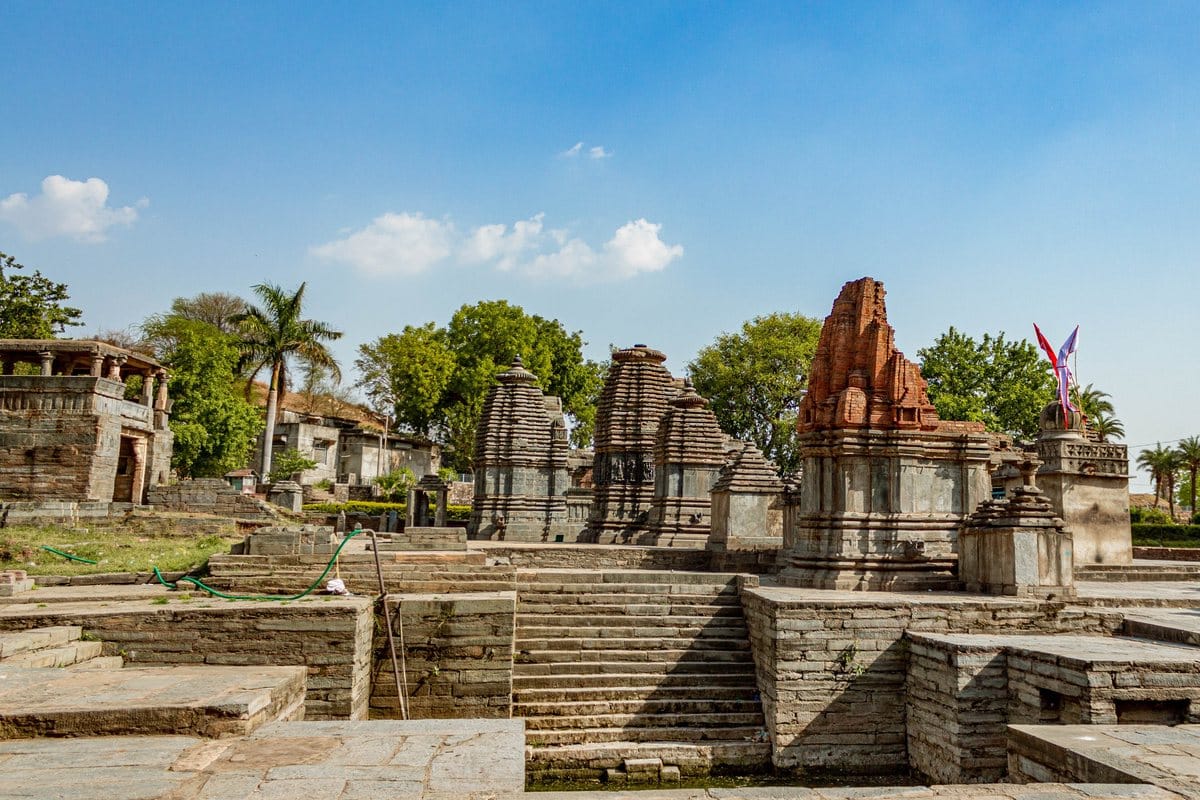
HistoryArthuna was known in antiquity as Utthunaka, and in the eleventh and twelfth centuries it served as the capital of the Paramara rulers of Vagad. A whole cluster of finely worked temples stood here in that age, reduced over the centuries to rubble — by invasion, it is said, and by simple weathering. What survives, scattered across the site, are the remains of Shiva and Jain shrines, their delicate carving and their old inscriptions, all still testifying to a vanished splendour. Look closely at the figures cut into the stone and the skill of those sculptors becomes obvious.
Madareshwar Mahadev Temple
LegendThe Madareshwar Mahadev temple sits inside a natural cave on a high hill in the eastern part of Banswara town, and is dedicated to Lord Shiva. The way into the cave is said to be very narrow, and by local account ascetics of an earlier age came here precisely because it offered the solitude their hardest penances demanded. At Shivratri the whole path fills with devotees and the queue for darshan stretches a long way back. From the summit the whole town of Banswara opens out below, a view that repays every step of the climb.
Abdulla Pir Dargah
History & legendThe Abdulla Pir dargah is the tomb of Sayyed Abdul Rasool Shaheed, a saint held in great reverence by the Dawoodi Bohra community. Tradition places him in this region many centuries ago — how many, no one can say for certain — spreading a message of peace and of common humanity. Every year an Urs is held at the shrine, drawing Bohra pilgrims from far afield. And what locals will tell you sets the place apart is who comes to pray: not Muslims alone, but Hindus and people of other faiths too, offering their chadars with the same devotion. That, they say, is the dargah's finest story.
Anand Sagar Lake
History & legendAnand Sagar is a man-made lake, and its story belongs to the royal house of Banswara. It is linked by tradition to Rani Lanchi Bai, queen of Maharawal Jagmal Singh — some accounts say she had it dug, others that he had it made for her — and it is her name that survives in "Bai Talab". Sacred kalpavriksha trees stand along the shore, and tradition holds that a wish made while standing beneath them will come true. Close by are the graceful cenotaphs of Banswara's former rulers. Towards evening the water, the old trees and those stone chhatris settle together into something quiet and unmistakably antique.
Keep going
Next on the road
Your Rajasthan Story Starts Here.
Tell us where you want to go. We will help you make the journey unforgettable.