
Har Mod ki Kahani
Jaipur
Jaipur, known the world over as the Pink City, is more than rose-washed walls and busy bazaars. Its forts and palaces each hold a story: latticed windows built for queens who could not be seen, a pleasure house sunk into a lake, a cannon that was fired only once, and stone instruments that measured the stars. Here are the city's best-loved landmarks and the tales behind them.
The stories
6 places, and what happened at each
Hawa Mahal
HistoryHawa Mahal was raised in 1799 by Maharaja Sawai Pratap Singh, a devoted follower of Krishna; by tradition, its silhouette is said to echo the god's crown. The deeper reason behind it is more human. Purdah was strictly observed in Rajput households then, and the queens could not step out among ordinary crowds. The king wanted them to watch the city's festivals, the Teej and Gangaur processions and the everyday bustle of the bazaar, without being seen themselves. So 953 tiny latticed windows were cut into the façade, and the breeze pouring through them keeps the palace cool even in high summer.
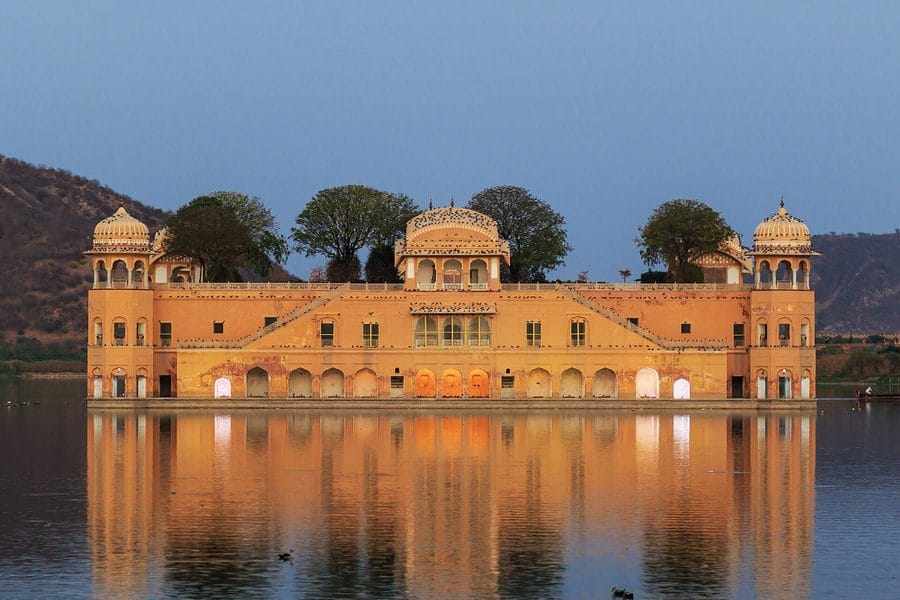
Jal Mahal
History & legendThis palace floating at the heart of Man Sagar Lake stands on water that is itself man-made. Long before Jaipur was founded, Raja Man Singh of Amer had a dam thrown across the Darbhawati river to carry the region through drought and secure its water, and the lake gathered behind it — it still bears his name. The palace is said to have been raised around 1699 under Sawai Jai Singh, though other accounts credit later rulers. Tradition holds that after a grand Ashwamedha yajna, he, his queens and the priests bathed and rested here. From the bank it looks single-storeyed, yet five floors exist — the lower four lie submerged.
Amer Fort
History & legendPerched on a hill in the Aravallis, Amer was once the capital of Jaipur's rulers. The palace was raised by Raja Man Singh I and enlarged by the kings who followed. Its heart lies in two places: the Shila Mata temple and the Sheesh Mahal. Tradition holds that Man Singh, returning from defeating Raja Kedar in Bengal, carried back a stone image of Kali from the sea there; installed here, she became Shila Mata. In the Sheesh Mahal, light a single candle and the mirrored ceiling breaks into a thousand stars — built, it is said, by a later king so his queen could sleep under a sky indoors.
Jaigarh Fort
History & legendRising directly above Amer Fort, Jaigarh was built by Sawai Jai Singh II — most accounts date it to 1726 — as a military stronghold guarding the Amer Palace and the royal family; it is also called the Fort of Victory. Inside stands Jaivana, said to be the largest wheeled cannon in the world. The tale goes that it was fired just once, as a test, and the ball travelled some 35 kilometres to the town of Chaksu, gouging out a pond where it fell. Jaigarh carries a second legend too: that the Kachhwaha dynasty's secret treasure lay hidden here, prompting a heavy government excavation in the 1970s.
Nahargarh Fort
History & legendFacing the city from the ridge above it, this fort was built in 1734 by Maharaja Sawai Jai Singh II. It was to be called Sudarshangarh, and the reason for the change is pure folklore. The ground it rose on, people say, belonged to a long-dead Rajput warrior named Nahar Singh Bhomia. Whatever the labourers built by day came down by night. Tantriks, the story goes, told the king the warrior's spirit resented a fort on his land. A small shrine in his name does stand within the walls, and the fort took the name Nahargarh, Nahar's home. Only then, tradition holds, was it finished.
Jantar Mantar
HistoryA UNESCO World Heritage Site, this observatory was raised in the 1730s by Sawai Jai Singh II, a ruler besotted with astronomy — though sources still differ on the exact year it was finished. The name explains itself: jantar means instrument, mantar means calculation. Jai Singh longed to track the movement of stars and planets, and since no reliable clock existed in his day, he had colossal scientific instruments carved from stone instead. Standing among them is the Samrat Yantra, the largest stone sundial in the world, said to still read local time from sunlight and shadow alone, to within about two seconds.
Keep going
Next on the road
Your Rajasthan Story Starts Here.
Tell us where you want to go. We will help you make the journey unforgettable.