
Har Mod ki Kahani
Nagaur
Nagaur wears its history lightly, but that history runs deep. In the age of the Mahabharata this stretch of country was called Jangaldesh, and its capital Ahichhatrapur is the town we now know as Nagaur. Three threads are woven through the land here: the courage of Rajput arms, the devotion of Sufi saints, and the tenderness of the bhakti poets. Forts, cenotaphs, shrines and temples carry those stories.
The stories
5 places, and what happened at each
Nagaur Fort (Ahhichhatragarh)
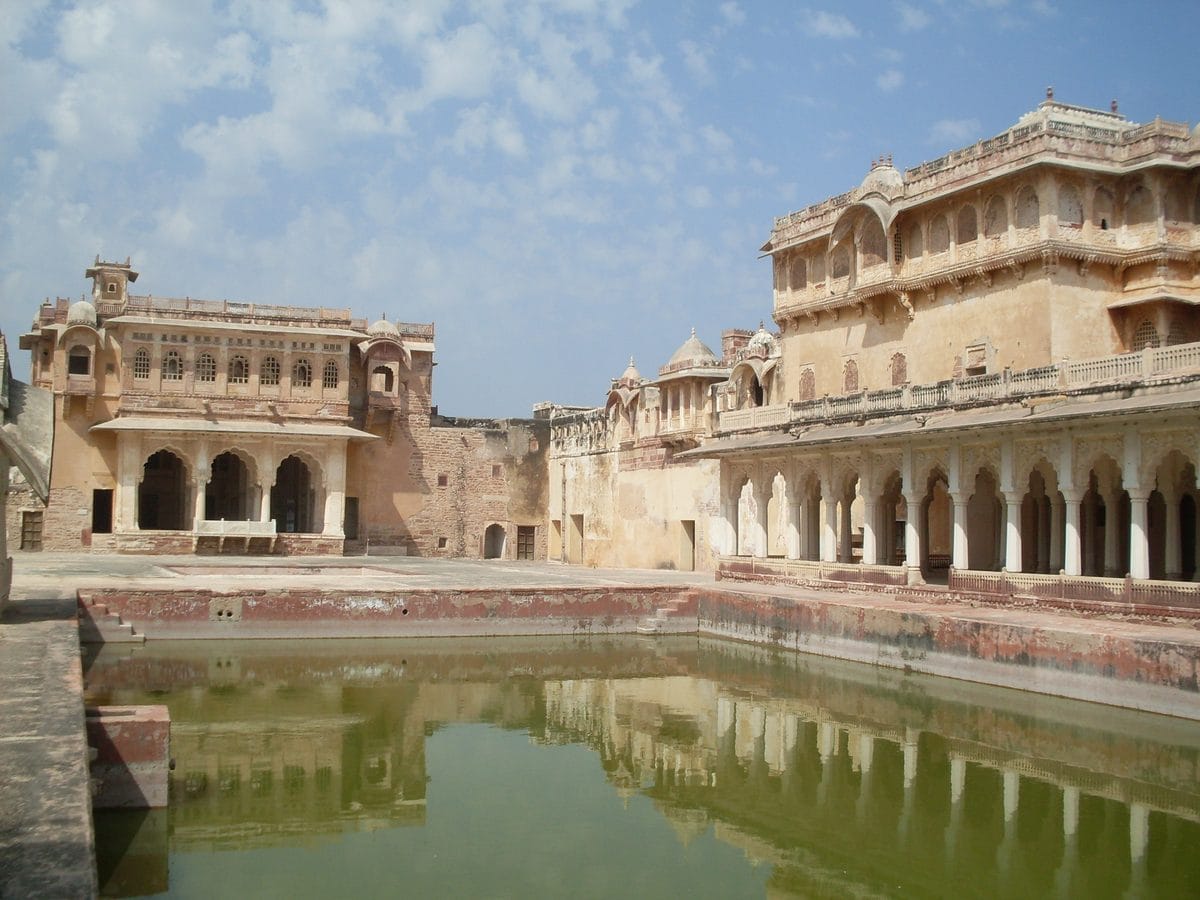
History & legendNagaur Fort is one of the few great forts of India built on flat open ground rather than a defensible hilltop. Tradition, rather than record, holds that Naga rulers raised its first mud ramparts around the fourth century, and that in the twelfth century Kaimas, a nobleman in Prithviraj Chauhan's service, rebuilt it in brick and stone. Its strangest tale concerns those walls: cannonballs fired at the fort, it is said, sailed clean over them and left the masonry untouched. Mughals, Rathores and Chauhans all fought here, and the walls remember every one of those campaigns.
Amar Singh Rathore Chhatri
History & legendBuilt of yellow, red and brown sandstone and carried on sixteen pillars, this graceful cenotaph stands in Nagaur, in what is known as Amar Singh Colony. Rao Amar Singh Rathore was a Marwar warrior whose pride mattered more than his life, and Shah Jahan had granted him Nagaur. The story goes that when Salabat Khan, one of the emperor's great nobles, called him a boor in open court, Amar Singh drew his dagger and struck him down where he stood. Then, legend says, he rode his horse Badal off the high wall of Agra Fort. Memorials to his queens, said to have followed him in sati, stand beside his own.
Meerabai Temple, Merta City
History & legendThis temple in Merta City, in Nagaur district, is a lovely piece of architecture — Rajputana in style, by the usual description — and among the most revered spots in the region. Mirabai was born, most accounts say, in the village of Kudki, though some place her birth at Merta itself. By tradition it was here, in Merta's palace and temple compound, that she spent her childhood, gave herself entirely to Krishna, and composed the devotional songs that would outlive every kingdom around her. Local belief holds that her whole spiritual journey began on this soil, and pilgrims still arrive singing her verses.
Tarkeen Dargah (Hamiduddin Nagauri)
HistorySet close to the walls of Nagaur Fort, this dargah honours Khwaja Hamiduddin Nagauri, counted among the closest and most trusted disciples of Khwaja Moinuddin Chishti of Ajmer. Among Muslims it is widely regarded as Rajasthan's second holiest shrine after Ajmer Sharif. Its grand gateway, known as Tarkeen ka Darwaza, is by tradition credited to Sultan Iltutmish, though sources differ. For centuries Hindus and Muslims have bowed their heads here side by side, which is why the place is spoken of less as a monument than as a living lesson in shared faith.
Khimsar Fort
HistoryKhimsar Fort stands where the Thar Desert begins, and today it is a celebrated heritage hotel — but it started life as something far sterner. It was raised in the sixteenth century, around 1523, by Rao Karamsi — reckoned the eighth son of Rao Jodha, who founded Jodhpur — and it is said to have served purely as a military outpost, keeping watch over hostile country. By tradition, only in the eighteenth century did the royal household move in, adding handsome palace apartments within the walls. A portion still belongs to their descendants, and the sand dunes nearby offer visitors a taste of desert life.
Keep going
Next on the road
Your Rajasthan Story Starts Here.
Tell us where you want to go. We will help you make the journey unforgettable.